


In a small living room, a few inches decide everything: whether there is room to walk past the coffee table, whether the sofa makes it through the front door, and whether the room feels open or crowded. Off-the-shelf sofas come in a handful of fixed sizes, which often means settling for "close enough". Because every What A Room sofa is built to order, you can size it to your room instead of the other way around.
Here is how to choose an apartment-size sofa that fits your space, your doorways, and the way you live.
Start with the room, not the sofa
Before you look at a single style, measure the space. Note the longest open wall where the sofa could go, the distance from that wall to the opposite wall or the nearest obstacle (a doorway, dining table, or kitchen island), and anything along that wall that needs to stay reachable, such as outlets, vents, radiators, or light switches.
Then plan for breathing room. Leave about 18 inches between the front of the sofa and your coffee table, and about 36 inches of clear walking path beside or behind the sofa. If a walkway drops below about 30 inches, the layout will likely feel cramped day to day. Add an extra inch or two of wiggle room to every measurement.
Measure the delivery path too
In apartments, the hallway and elevator are often a tighter squeeze than the living room itself. Measure every doorway, hallway, stairway, and elevator the sofa will pass through, including the interior width and height of each doorway and how far the door opens. Note any tight corners where the sofa will need to pivot.
For sofas and sectionals, the key number is the diagonal depth: the measurement from the top back corner to the bottom front corner of the sofa, not counting pillows. That diagonal needs to be smaller than your doorway width. Our Measuring Guide shows exactly how to take each measurement.
Most sofa deliveries qualify for white glove service, where the team unpacks, assembles, and places the sofa for you, then takes the packaging away. Standard white glove service covers up to three flights of stairs, and four or more flights add a $75 flat fee.
What size sofa do you need?
Width is the first number most people look at. Because our sofas are custom built, many collections let you choose width in small steps. The Daphne sofa chaise, for example, runs from 80 inches up to 136 inches in 4-inch increments, so you can land on the width that fits your wall rather than the nearest stock size.
When deciding on width, think about what else needs to share the wall. Leave room for a side table or lamp at one end if you want one, and make sure the sofa does not block a doorway or the natural path through the room.
Depth is the hidden space-eater
Overall depth, measured from the front of the seat to the back of the frame, is easy to overlook, but in a small room every inch of depth comes straight out of your walking space. Our sofas range from 36 to 48 inches deep overall across the lineup. For rooms under about 12 feet wide, an overall depth of 36 to 38 inches is generally the upper limit before a sofa starts to dominate the room.
This is also what people usually mean by a "narrow couch": not a short sofa, but a shallow one. Because we build to custom depths, you do not have to choose between two stock sizes if the right answer for your floor plan sits in between. Just keep in mind that a shallower overall depth means a shallower seat, so if you love to lounge, find the balance that works for you.
Choosing the right shape for a small space
-
A sofa: The most flexible choice for tight rooms and irregular layouts, and easy to pair with an accent chair for extra seating.
-
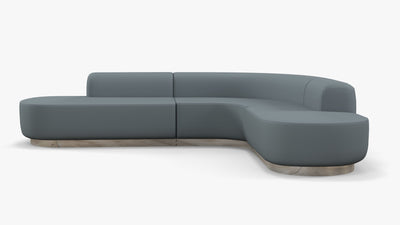
A sofa chaise: The most space-efficient sectional shape, with a chaise extending from one end only. It gives you a place to put your feet up without the full footprint of an L-shape. Choose the chaise side to suit your room.
-
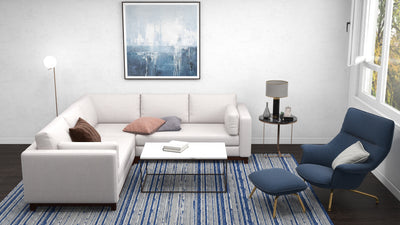
A small sectional: Possible in more rooms than people expect. Our Small Sectionals guide covers the minimum room sizes and configurations that work.
-
A sofa bed: A practical choice for studios and one-bedroom apartments that need to host guests. Browse our Sofa Beds collection.
Make a sofa look lighter in the room
Two sofas with the same dimensions can feel very different in a small space. A few choices make a big visual difference:
-
Raise it up. Taller legs let light and sightlines pass under the sofa, so it reads lighter. Low, platform-style bases feel cozy in large rooms but can look heavy in small ones.
-
Slim the arms. Low track arms at about 22 to 24 inches add much less visual bulk than tall, boxy arms at 28 to 30 inches.
-
Choose a lighter color in low light. In rooms without much natural light, warm, lighter neutrals reflect more light and make the space feel larger.
-
Keep the silhouette clean. A tight back gives a tailored outline with no loose cushions adding bulk.
See it in your room before you order
Scale is hard to judge from product photos, which are often staged in rooms much larger than a typical apartment. Send us your floor plan and room measurements, and our design team will create free 2D and 3D renderings showing which sizes and shapes fit, and flag any clearance issues before you place an order.
Frequently asked questions
What size sofa is best for a small living room?
The right size depends on your wall length and the space you need to walk around it. Plan for about 18 inches between the sofa and coffee table and about 36 inches of clear walking path, then choose the widest and deepest sofa that still leaves that room. Custom sizing lets you match the sofa to your measurements exactly.
How do I measure for a sofa?
Measure the wall where the sofa will go, the distance to the nearest obstacle, and every doorway, hallway, stairway, and elevator on the delivery path. For delivery, compare the sofa's diagonal depth to your narrowest doorway width. Our Measuring Guide walks through each step.
What is an apartment-size sofa?
There is no official standard. The term generally describes a sofa with a shorter width and shallower depth than a typical full-size sofa, built to fit smaller rooms and tighter delivery paths. Custom sizing lets you decide exactly how compact yours should be.
Can a sectional work in a small apartment?
Often, yes, if the configuration is right. A sofa chaise is the most compact sectional option. Our Small Sectionals guide explains which layouts work in smaller rooms.
How deep should a sofa be for a small room?
For rooms under about 12 feet wide, an overall depth of around 36 to 38 inches usually keeps the room feeling open. If you prefer a deeper seat, plan the rest of the layout around the extra inches.


