


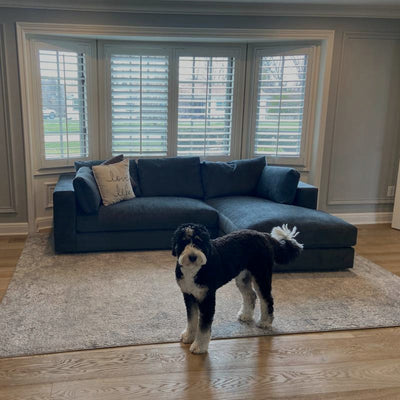
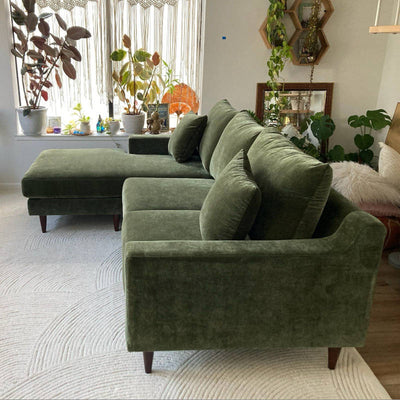


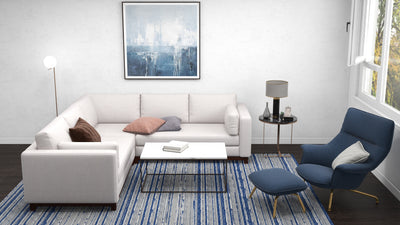

It is one of the first real decisions in furnishing a living room, and it shapes everything that follows. One large connected piece, or two separate ones?
There is no universally correct answer. There is a correct answer for your room, and it comes down to four things: how the room is shaped, where people walk through it, how many focal points it has, and how often you rearrange. Here is how to work through each of them.
The short answer
Choose a sectional when the room has one clear focal point, when you want maximum seating in a single footprint, and when the layout is settled enough that you are not planning to move things around often.
Choose a sofa and loveseat when the room has more than one focal point, when you need to keep walkways open, when you want conversational seating that faces inward, or when you expect the layout to change.
Now the detail behind that.
Sectional vs sofa and loveseat at a glance
|
|
Sectional |
Sofa and loveseat |
|
Seating per footprint |
Higher. Corner and chaise seats add capacity without adding walkway loss |
Lower. Two arms on each piece use space that a sectional turns into seating |
|
Best room shape |
Square or wide rooms, open plan spaces with one clear zone |
Long and narrow rooms, rooms with two focal points |
|
Traffic flow |
Can block a path if the long side lands across a walkway |
Easier to route around, since you can leave a gap between pieces |
|
Flexibility |
Fixed once placed. Moving it usually means rethinking the room |
High. Angle, separate or move pieces independently |
|
Conversation |
Great for facing a TV or fireplace together |
Better for face to face conversation |
|
Lounging |
Excellent, especially with a chaise or bumper |
More limited unless you add an ottoman |
|
Moving house |
Needs planning around doors and stairwells |
Easier to move and easier to reuse in a different room |
Start with the tape measure, not the catalogue
Before you weigh style, get three numbers: the usable wall lengths, the width of the walkways you need to keep clear, and the dimensions of every door, hallway and stairwell the piece has to pass through on delivery day.
As a working guideline, leave about 30 to 36 inches for main walkways and around 14 to 18 inches between the front of your seating and the coffee table. Sketch the footprint on the floor with painter's tape before you decide anything. A layout that looks generous on a floor plan can feel tight the moment you walk it.
The delivery measuring guide walks through the access measurements, and if you would rather have someone else do the visualizing, the free design consultation turns your floor plan into 2D and 3D renderings so you can compare both options in your actual room before committing.
When a sectional is the better choice
A sectional wins on seating efficiency. Every arm you remove is space converted into a seat, so a sectional will almost always seat more people in the same square footage than a sofa and loveseat pairing.
It is the stronger option when:
• The room has one focal point. A television, fireplace or window that everyone naturally orients toward suits a single wrapping piece.
• You have a corner to fill. L shaped sectionals turn an awkward corner into the most used seat in the house.
• Lounging matters as much as sitting. A chaise sectional gives you a full length surface without a separate ottoman.
• You entertain in volume. U shaped sectionals seat a crowd and keep everyone in one conversation.
• The room is open plan. A sectional defines a living zone in a space with no dividing walls, acting as a soft boundary between the living area and everything around it.
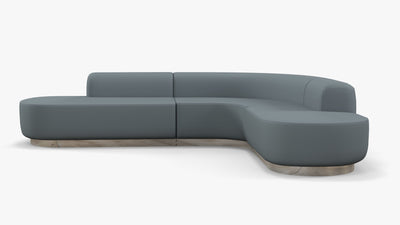
If your room is open on more than one side, a curved sofa or sectional is worth considering. Curves soften a large open space and read as less blocky than a hard L when the back of the piece is visible from the rest of the room.
When a sofa and loveseat is the better choice
Two pieces give you something a sectional cannot: the ability to change your mind.
It is the stronger option when:
• The room has two focal points. A fireplace on one wall and a television on another is very hard to serve with a single piece, and straightforward with two.
• The room is long and narrow. Facing two pieces across a coffee table uses a corridor shaped room far better than an L that eats one end of it.
• Walkways are tight. You can leave a deliberate gap between two pieces. A sectional is continuous by design.
• You rearrange seasonally. Two pieces can be angled, separated, or split between rooms.
• Conversation is the priority. Seating that faces inward encourages people to talk to each other rather than all face the same direction.
• You expect to move. Two smaller pieces are far easier to fit through a stairwell and far easier to reuse in a home with a different shape.
At What A Room, a loveseat is simply a custom sofa built at a shorter width, so you are not limited to whatever two piece set a manufacturer happened to produce. Browse the custom sofas collection and specify each piece to the length your room actually wants.
Where custom changes the math
Most of the sectional versus sofa and loveseat debate exists because standard furniture comes in fixed sizes. You are choosing between an 84 inch sofa that leaves an awkward gap and a 96 inch one that crowds the doorway, so you end up picking the configuration whose compromises annoy you least.
When the furniture is built to your dimensions, that framing falls away. A sectional does not have to be too long for the wall. A loveseat does not have to be four inches wider than the alcove. You specify the size, the seat depth, the cushion firmness and the fabric, and the piece fits the room instead of the room accommodating the piece.
That is worth knowing before you decide, because it changes the question. Instead of asking which standard configuration is least wrong for your space, you are asking which layout you actually want to live with. Every collection is available in multiple configurations, so the same style can be built as a sofa, a loveseat, a chaise sectional or a full U.
It also means you can mix rather than choose. A sofa paired with a matching loveseat from the same collection, or a sectional paired with an accent chair, can give you the seating capacity of one option and the flexibility of the other.
A quick way to decide
Answer these five questions and the direction usually becomes obvious.
• How many focal points does the room have? One points to a sectional. Two points to a sofa and loveseat.
• Does anyone need to walk through the seating area to get somewhere else? If yes, two pieces make that easier to route.
• Do you lounge or do you sit? Lounging favours a chaise. Sitting and talking favours facing pieces.
• How settled is the layout? If you rearrange often, keep the pieces separate.
• How many people do you seat on a normal weekend? If the honest answer is five or more, a sectional gets you there in less floor space.
Frequently asked questions
Is a sectional or a sofa and loveseat better for a small living room?
It depends on the shape rather than the size. In a small square room, a compact sectional often seats more people than two separate pieces would, because it removes two arms and uses the corner. In a small narrow room, a sofa and loveseat usually works better, because you can leave a walkway between them. Measure your walkways first and let that decide.
Does a sectional make a room look smaller?
Not necessarily. What makes a room feel smaller is blocked sight lines and blocked walkways. A low back sectional with exposed legs, sized correctly for the wall, often reads lighter than two bulky pieces with high arms. Scale and leg height matter more than piece count.
Can you use a loveseat with a sectional?
Yes, and it is a common solution in larger or open plan rooms. A sectional anchors the main zone while a loveseat or a pair of accent chairs creates a secondary seating area, which works particularly well when the room has a second focal point.
How much seating do you get from each?
As a rough guide, a standard sofa and loveseat pairing seats around five people, while a comparable L shaped sectional in the same footprint typically seats five to six, and a U shaped configuration can seat seven or more. With custom sizing you can push either number by adjusting the width.
Which is easier to move to a new home?
A sofa and loveseat. Two smaller pieces navigate doorways and stairwells more easily and are more likely to suit the proportions of a different room. If you order a sectional, check your access measurements carefully before delivery day.
Still deciding?
You do not have to choose from a screen. Order free fabric samples to see materials in your own light, or send your floor plan through the free design consultation and get 2D and 3D renderings of both layouts in your actual room.
When you are ready, browse all custom sofas and sectionals and build the configuration your space has been asking for.


