


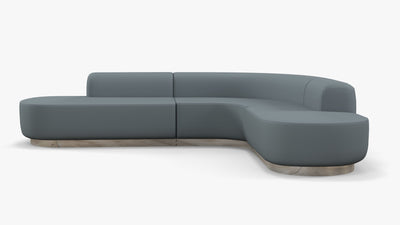

"How long should a couch last?" sounds like it should have a simple answer, but a sofa is really several components built together, and each one wears at its own pace. The frame might last for decades while the cushions flatten in a few years. A sofa's real lifespan is usually set by its weakest part.
This guide breaks down what determines how long a sofa lasts, how to spot quality on a spec sheet, and how to tell when a sofa needs repair or replacement.
The short answer
A sofa lasts as long as its frame, suspension, foam, and fabric hold up, and those vary a great deal from one sofa to the next. Here is what What A Room builds into each sofa:
-
Frame and suspension: Kiln-dried solid wood with corner blocks and 8-gauge sinuous springs, backed by a limited lifetime warranty.
-
Seat foam: 2.5 lb high-resilience foam engineered to keep its shape for more than 10 years, compared with the 3 to 7 years typical of lower-density foam.
-
Fabric: Many of our fabrics are rated to 100,000 double rubs, which is considered commercial grade.
What determines sofa lifespan, part by part
The frame
The frame is the skeleton of the sofa, and when it fails, the sofa is usually done. Solid wood frames that have been kiln dried hold up best, because removing moisture keeps the wood from warping or developing mildew, even in humid climates. Corner blocks reinforce each joint so the frame does not loosen over years of use. Frames made from engineered wood, plywood, or particleboard are lighter and cheaper but more prone to loosening and cracking.
The suspension
Springs support the seat and spread your weight. Heavy-gauge sinuous springs (ours are 8-gauge) hold their tension over time. Simpler webbing suspension, common on low-cost sofas, tends to stretch and sag sooner.
The foam
Cushions are usually the first thing to wear out, and foam density is the biggest reason why. Density is measured in pounds per cubic foot. Many mass-produced sofas use 1.5 to 2.0 lb foam to keep costs down, while our seat cushions use 2.5 lb high-resilience foam, a grade usually found in commercial furniture. Denser foam withstands weight and pressure better and recovers its shape instead of developing permanent dips.
Firmness is a separate spec from density. Firmness describes how the cushion feels, while density describes how long it will last. A soft cushion on a dense core can outlast a firm cushion on cheap foam.
The cushion wrap and fill
Foam cores are usually wrapped for comfort. We wrap ours in Dacron or Trillium, a down-alternative fill that does not clump or flatten the way natural down can, and needs much less fluffing. Our Sofa Cushion Fill Guide compares the options.
The fabric
Fabric durability is often described in double rubs, a measure of how many back-and-forth abrasion cycles a fabric withstands in testing. A rating of 100,000 double rubs is considered commercial grade. Tight weaves, performance fibers, and solution-dyed fabrics generally wear and clean best over time. Loose weaves and delicate natural fibers show wear sooner in high-traffic spots.
How you use your sofa matters too
Two identical sofas can age very differently. Daily use, kids, pets, direct sunlight, and cleaning habits all play a role. A few habits make a real difference:
-
Rotate split seat cushions regularly so they wear evenly.
-
Fluff loose cushions to keep the fill evenly distributed.
-
Vacuum with an upholstery attachment to keep grit from wearing down the fabric.
-
Treat spills right away, using a cleaner that matches the fabric's cleaning code.
-
Avoid harsh chemicals, which can damage fabric and are not covered by warranty.
Our Furniture Care Guide has detailed care instructions.
Normal break-in versus real wear
It is normal for new cushions to soften slightly as they break in. That is not a defect. A useful line between normal and abnormal is the one in our warranty: visible sagging or flattening that does not recover after fluffing and 24 hours of rest is considered an abnormal loss of resiliency.
Signs it is time to repair or replace a sofa
-
Cushions stay flat even after fluffing and a day of rest.
-
The frame creaks, wobbles, or shifts when you sit down.
-
The seat sags in a way that is not just the cushion, which can point to the springs.
-
The fabric is worn through, torn, or permanently stained.
Not every one of these means buying a new sofa. If the frame and springs are still solid, replacing the cushions or covers can give a sofa a second life. What A Room customers can order replacement cushions and covers at any time.
What durable looks like on a spec sheet
When comparing sofas, look for these details. If a seller will not tell you, it is reasonable to wonder why:
-
Kiln-dried solid wood frame with reinforced corners
-
Heavy-gauge sinuous springs
-
Seat foam density of 2.5 lb or higher
-
Fabric abrasion rating in double rubs
-
A clear warranty that separates frame coverage from cushion and fabric coverage
Frequently asked questions
How long do couches last?
It depends on construction. The cushions are usually the first part to wear, so foam density is the best single predictor. Our 2.5 lb high-resilience foam is engineered to hold its shape for more than 10 years, and our frames and suspension carry a limited lifetime warranty.
How often should you replace a couch?
There is no fixed schedule. Replace or repair when the cushions no longer recover, the frame feels loose, the seat sags, or the fabric is worn through. If the frame is still solid, new cushions or covers may be all you need.
What is the most durable sofa fabric?
Tightly woven performance fabrics with a high double rub rating are generally the most durable for everyday use. Solution-dyed fabrics also hold their color and clean well over time.
What foam density is best for a sofa?
Higher density lasts longer. Our seat cushions use 2.5 lb high-resilience foam, which is denser than the 1.5 to 2.0 lb foam common in mass-produced sofas.
Is a kiln-dried hardwood frame worth it?
Yes, if you want a sofa that lasts. Kiln drying removes moisture so the wood does not warp or grow mildew, and solid wood holds joints more securely over time than engineered wood.
What is a good rub count for a sofa?
A rating of 100,000 double rubs is considered commercial grade, and many of our fabrics meet it.


